
How to Check Criminal History in Parker County
Match the channel to the question. The Parker County Courts hub routes readers to Judicial Record Search for pending or resolved district and county court cases. The sheriff's Jail Search is the faster source for current detention and recent booking data. A Texas DPS public name search reaches reported convictions and deferred adjudications from across the state, but it can omit a new Parker County filing. City citations may stay in the municipal court that issued them.
- Identify whether the target is a court case, booking, police report, statewide outcome, prison record, or registry entry.
- Gather the legal name, a known prior name, date of birth, date range, and exact cause, incident, or booking number when available.
- Search the official local channel first for a fresh Parker County event, then check the relevant state system.
- Compare court, charge, date, and case events before treating a name result as the same person.
- Request the underlying file or certified copy from the clerk or agency when the record must be read in full.
A no-hit is not proof of no record. It can mean the wrong court, a spelling mismatch, a sealed result, slow reporting, or a record that is not part of that portal.
Four Parker County Criminal Record Paths
One event can create several records. An officer's incident or arrest report explains the alleged event and probable cause. Parker County Jail creates a separate booking and custody entry. The prosecutor's filed allegation becomes a criminal court case, and Texas DPS later links reportable arrest, prosecutor, court, and supervision data in its Computerized Criminal History cycle. Each source has a different owner and purpose.
- Incident or arrest report
- The arresting agency records what its officers reported about the event.
- Booking or custody record
- Parker County Jail records intake, booked charges, bonds, holds, and custody.
- Court file
- The District or County Clerk preserves the filed charge, docket, rulings, and judgment.
- State criminal history
- Texas DPS provides the public reported conviction and deferred-adjudication layer.
The DPS criminal-history reporting explanation describes how those agency submissions form a state record. A local file can appear before its outcome reaches DPS.
Official Texas Background Checks
The Texas Department of Public Safety Crime Records Division maintains CCH. Its public Criminal History Name Search provides convictions and deferred adjudications that Texas law makes public. The service uses prepaid credits. Current DPS instructions state that a credit costs $1, card purchases add 2.25% per credit plus a $0.25 transaction fee, and even a no-match search consumes a credit. Soundex can return differently spelled names, so full date of birth and middle name can help narrow results.
The official DPS search instructions explain the product, credit rules, and limits.
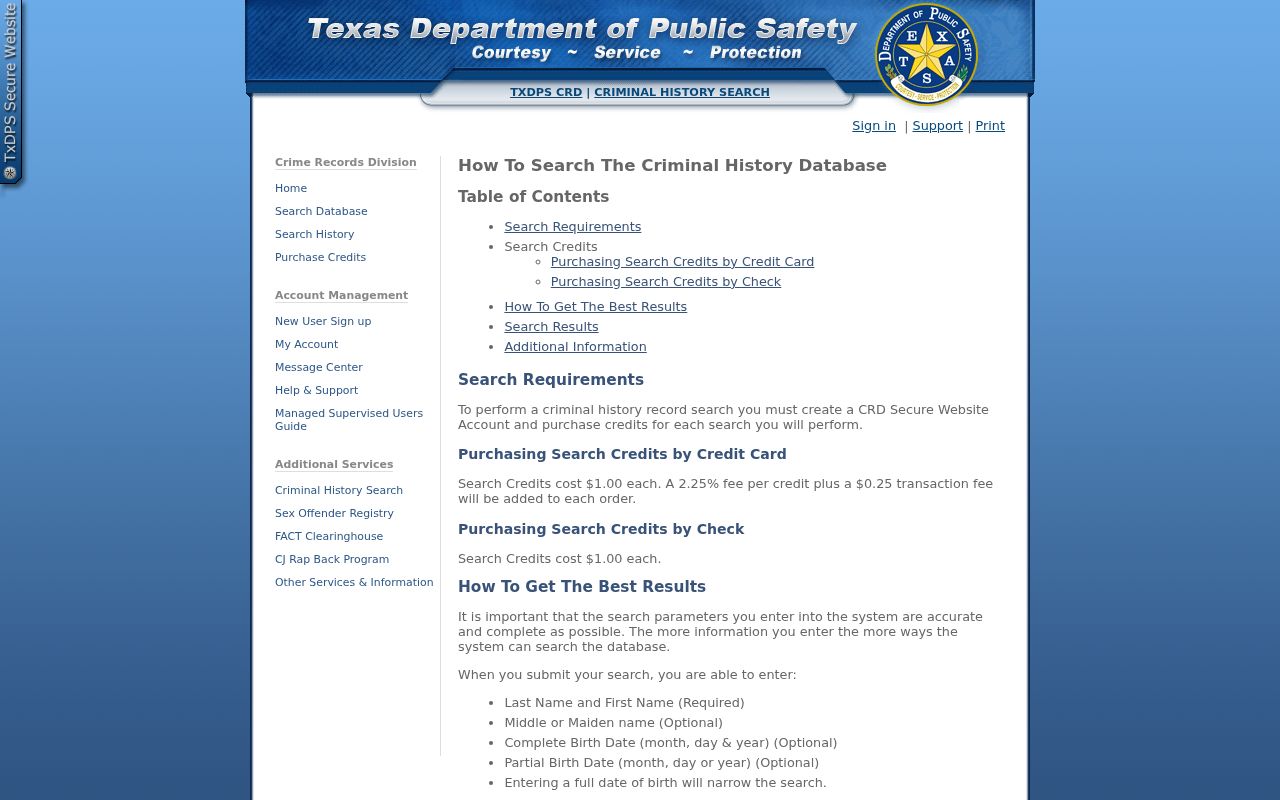
The official screen is a statewide public name-search route, not a substitute for Parker County case documents or fingerprint identification.
| Official Product | Amount | Main Limit |
|---|---|---|
| DPS online name search | $1 credit plus stated card fees | Conviction and deferred data; no-hit uses a credit |
| CR-42 mail search | $10 per person | Identifier-based request by check or U.S. money order |
| DPS fingerprint component | $15 | Correct personal-review or authorized route required |
| Ordinary FAST capture example | $10 | Program totals can differ |
Parker County Fingerprint Record Checks
A name and birth date can narrow a result, but only fingerprints positively link a person to a DPS record. Someone reviewing their own Texas history should follow the current DPS personal-review instructions and use the supplied service code. The Criminal History Inquiry Unit can be reached at 512-424-2474, option 2. FAST appointments use IdentoGO, and the scheduler should be checked with Parker County ZIP codes because enrollment locations and hours can change.
The official FAST and IdentoGO enrollment portal handles the appointment path.
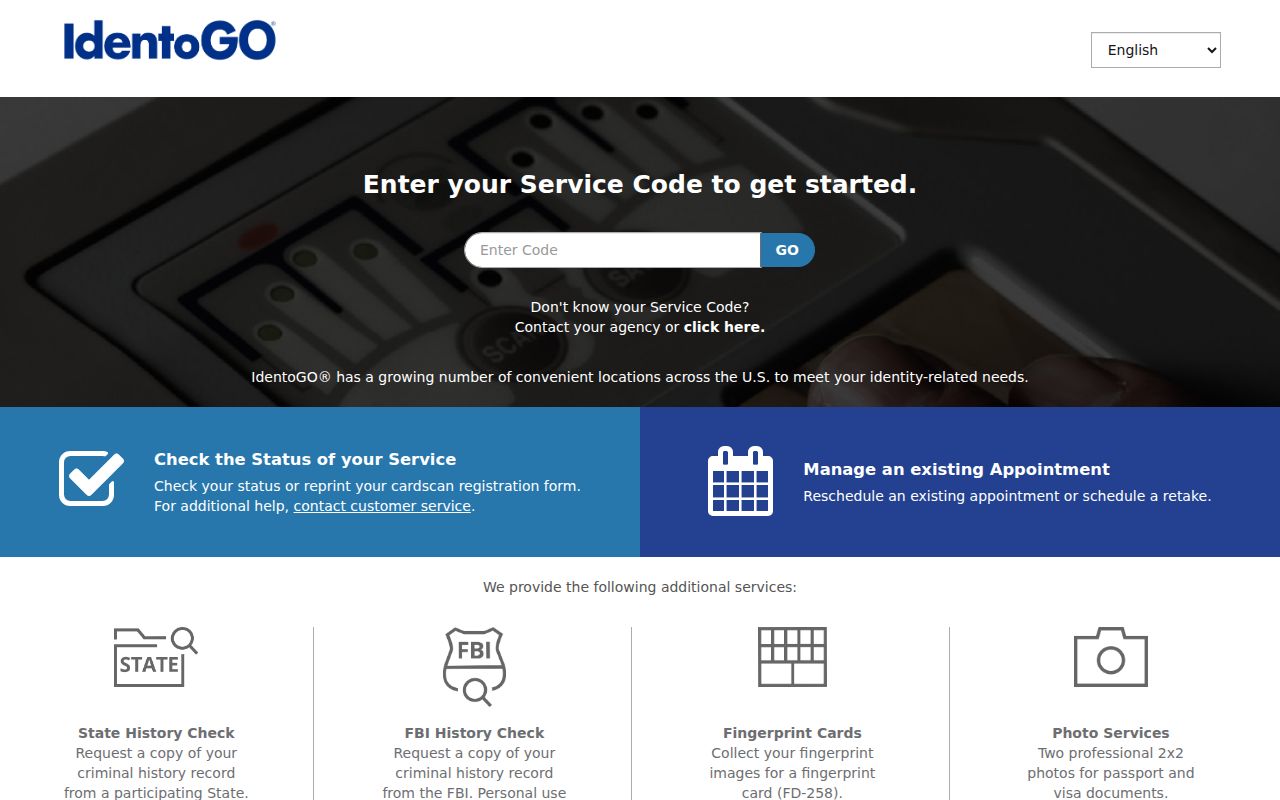
This screen helps a Parker County resident use the correct service-code process without relying on a retailer listing or inventing an authorization code.
Types of Criminal Records
Parker County criminal records reflect the office that created them. Sheriff and city police reports can contain an event number, date, location, allegations, narrative, officer, evidence, and witness data, with lawful redactions. Jail records cover intake, booked charge, bond, holds, release, and current custody. District and county court files center on the cause number, formal charge, docket, plea, orders, disposition, judgment, sentence, costs, and appeal events.
- Warrants: an arrest warrant, bench warrant, capias, and capias pro fine arise through different court events.
- Community supervision: Parker County CSCD handles adult probation-like supervision, not parole.
- State custody: TDCJ records sentenced prison custody rather than county pretrial detention.
- Registry entries: Texas DPS publishes specified sex-offender registration information, not a general rap sheet.
The record's label does not prove guilt. An arrest states an event, a charge states an allegation, and a judgment states the court's result.
Parker County Criminal Case Search Fields
Parker County Judicial Record Search can route to case or jail records. The vendor layout may change, so use the controls actually shown. Search an exact cause number first. For a name search, add a first name and a sensible date range, then filter by court or status if those fields appear. Review case detail rather than relying on the first matching line.
| Control | Type | Practical Use |
|---|---|---|
| Search type | Tab or menu | Choose court or jail records. |
| Last and first name | Text | Use the legal name and narrow common surnames. |
| Case number | Text | Targets one Parker County court file. |
| Date range | Date controls | Limits filing, event, or booking dates by module. |
| Court or status | Menu | Separates divisions and current case states. |
The statewide re:SearchTX portal adds Cases, Filings, Text, and Hearings search modes, plus filters, exports, and saved searches.
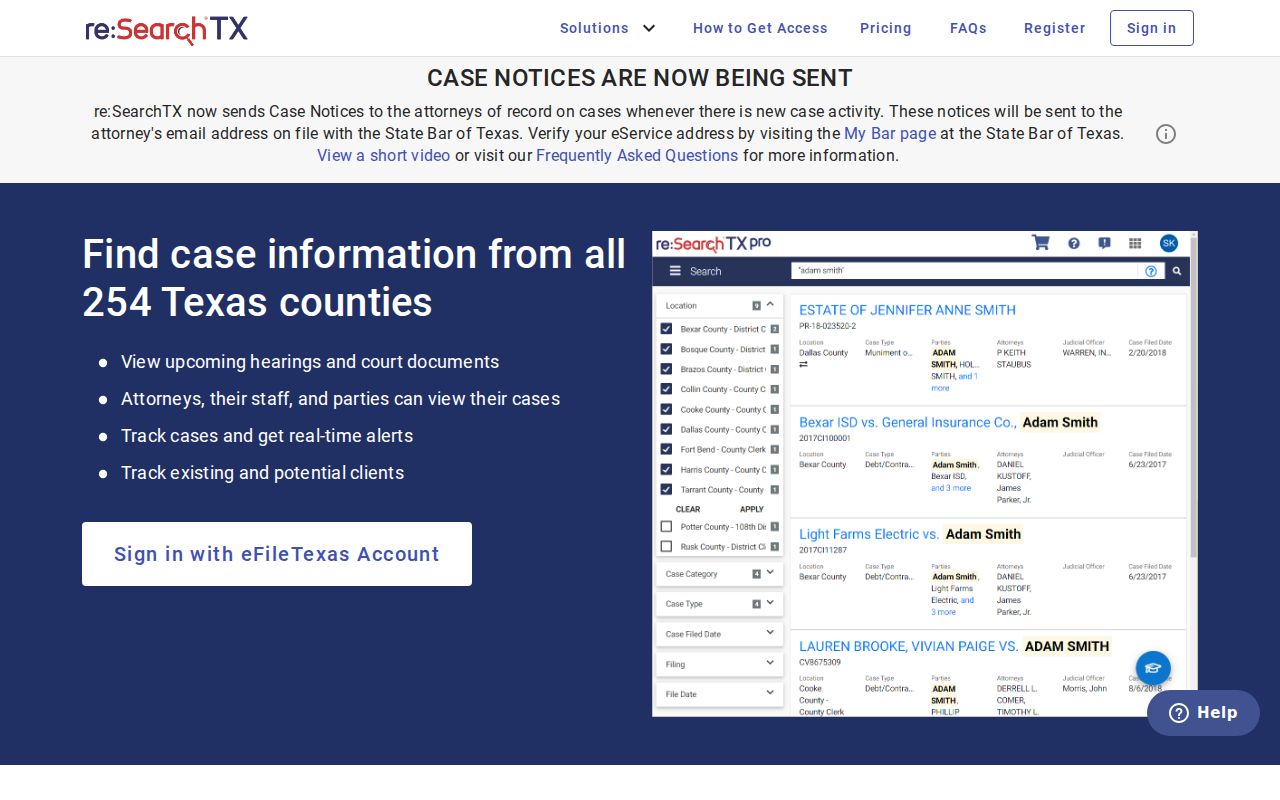
The image marks a useful second route, though court participation and document coverage vary and the local clerk remains authoritative.
What a Parker County Criminal Record Shows
The content depends on the system. CCH can link identifiers to an arrest cycle, prosecutor action, court charge, disposition, sentence, supervision, and custody entries. A court case instead follows one cause number through filings and rulings. Parker County booking data focus on intake, the booked charge, agency, bond, hold, and custody. Public products may suppress private identifiers.
| Name and Identifiers | Legal and alias names, birth data, physical details, SID or FBI number where lawfully displayed. |
|---|---|
| Arrest and Booking | Agency, event date, allegation, booking number, bond, hold, and custody data. |
| Filed Charges | Court, cause number, statute, count, and offense class or degree. |
| Disposition | Conviction, dismissal, acquittal, deferred adjudication, or another case result. |
| Sentence | Confinement, fine, costs, or community-supervision terms in the judgment. |
| Custody Status | County jail, state prison, release, or supervision data in the proper system. |
Verify each count. A multi-count Parker County case can end in more than one type of disposition.
Parker County Jail Search Limits
The sheriff's official Jail Search uses a legal first and last name. Parker County instructions allow a first initial plus an asterisk wildcard, but the newer records software does not offer booking-date search. If the portal fails, call the booking desk at 817-594-4208. Older or hidden booking detail can be requested in writing from the sheriff or at jail.records@parkercountytx.com.
A current county booking is not a state-prison record. The TDCJ Online Inmate Search covers sentenced state custody.
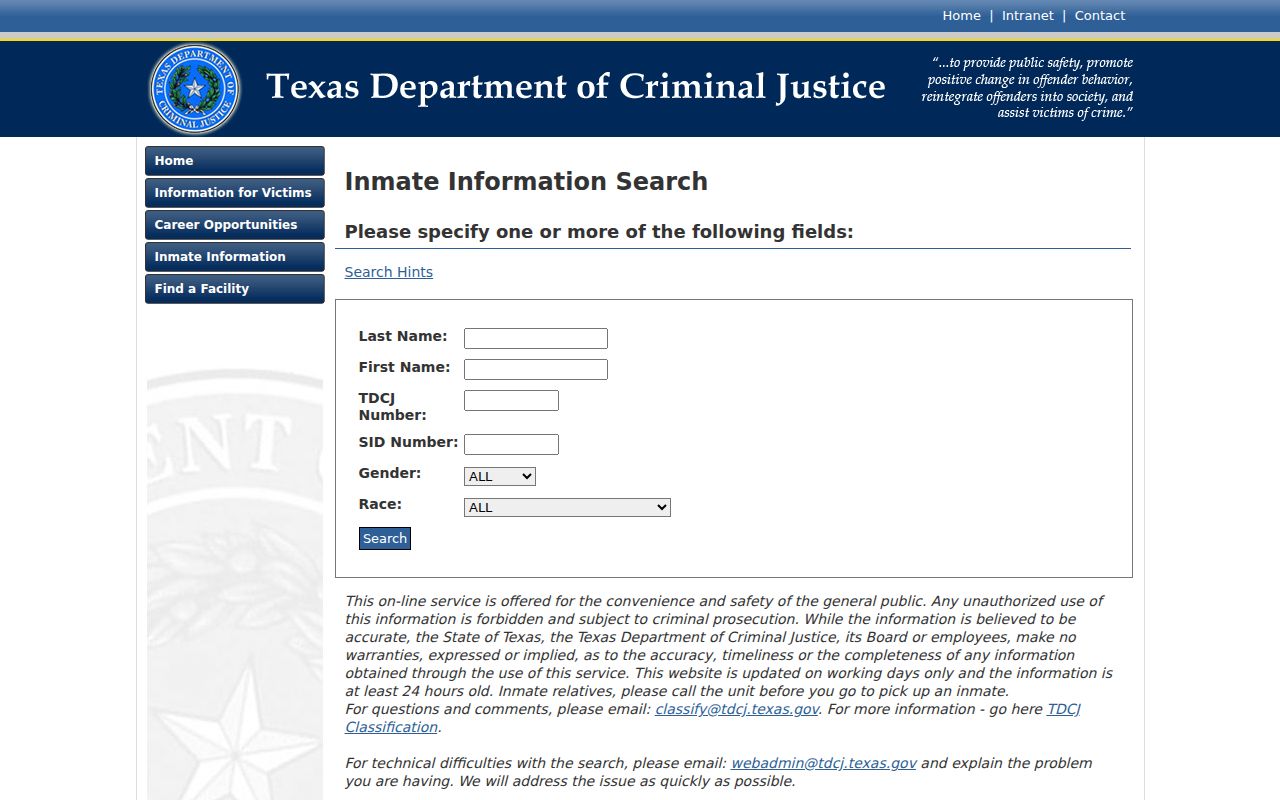
The state locator shown here belongs after transfer to TDCJ; it should not be used to test whether someone is in Parker County Jail now.
Note: The sheriff's selected press releases are not a complete daily arrest log and should never replace the jail, agency, and court channels.
Public Access Laws
The Texas Public Information Act gives a right to inspect or copy public information held by a government body, but the request must reach the right custodian. Parker County need not answer questions or create a new report. Chapter 411 also keeps broader criminal-history record information confidential except where law permits disclosure. The public DPS name product is the authorized route for reported convictions and deferred adjudications.
Key statutes:
Government Code §§411.083 and 411.135 set the confidential baseline and public conviction/deferred scope.
Code of Criminal Procedure §§66.102-.103 identify reportable data and reporting agencies.
Government Code Chapter 552 governs public inspection, copies, redactions, and agency response duties.
Family Code §58.008 restricts juvenile justice information, while Occupations Code §1701.661 sets special body-camera request rules.
Sheriff records requests must be written. Send a focused request to April Little by mail or in person at 129 Hogle Street, Weatherford, TX 76086, email april.little@parkercountytx.com, or fax 817-594-7809. A phone call is not a valid PCSO open-records submission.
Finding Parker County Police Reports
The arresting agency owns its incident report even when Parker County Jail later books the person. A sheriff report goes to PCSO. Weatherford, Willow Park, Aledo, Hudson Oaks, a constable, or a DPS trooper can create a separate record that must be requested from that agency. Ask for an incident number, date and time range, location, record type, and preferred electronic format. Body-camera and 911 requests need enough detail to identify the event.
Springtown is another local agency in the county. Its official police department page identifies that city channel.
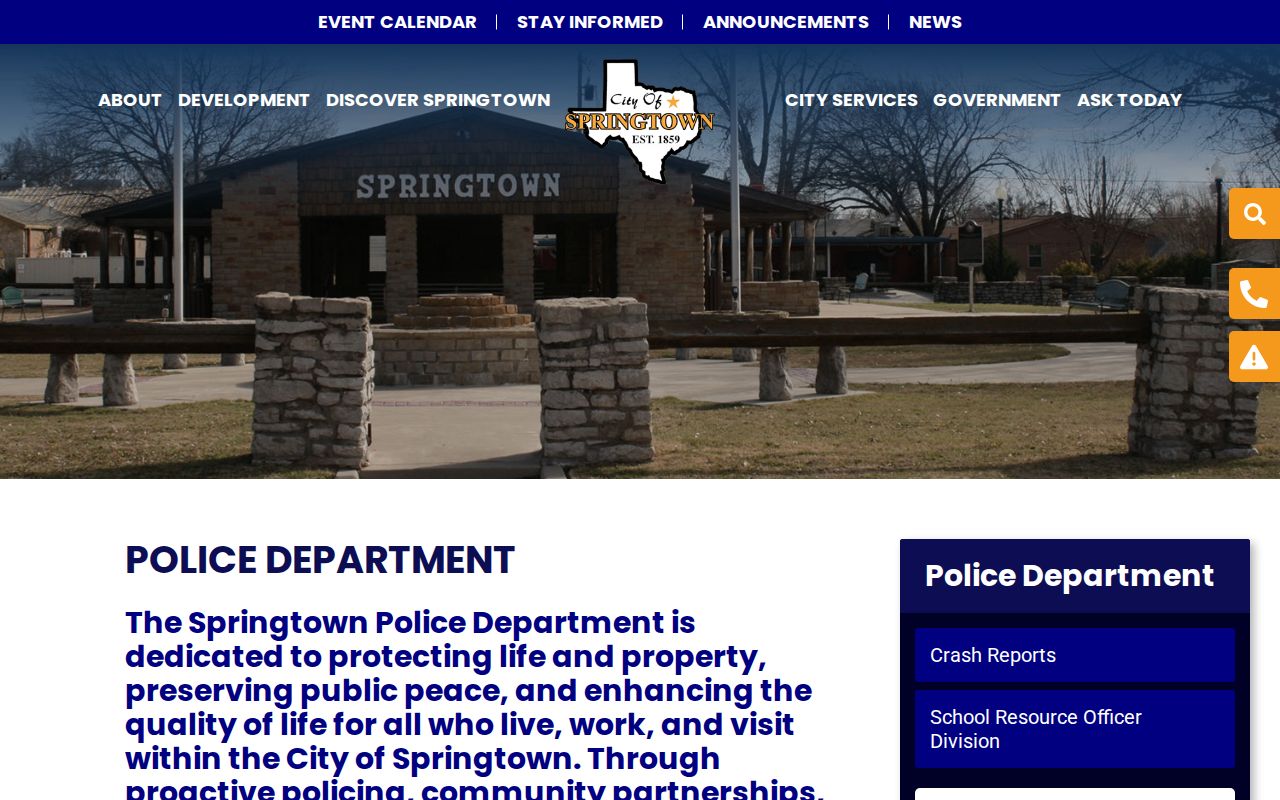
This local source illustrates why an arrest report must be traced to the agency that wrote it, rather than requested from every county office at once.
Sealed, Expunged & Restricted
Texas expunction under Code of Criminal Procedure Chapter 55A generally orders qualifying records returned, deleted, or destroyed. An order of nondisclosure under Government Code Chapter 411 limits public disclosure but leaves specified government and criminal-justice access in place. They are different remedies. A dismissal alone does not always qualify an entire arrest cycle for expunction, especially when another charge remains or prosecution is still possible.
Parker County lists a current expunction filing fee of $350 in the researched clerk materials, subject to verification on the live fee sheet. A sound filing begins with the arresting agency, booking number, all charges, every cause number, final dispositions, and each agency that holds part of the cycle. Juvenile records, victim details, license numbers, Social Security numbers, and other protected information follow separate access rules.
Expunction generally removes qualifying records as the order directs, subject to statutory exceptions. Nondisclosure leaves a record in place while restricting public disclosure and preserving specified government access. Neither remedy should be assumed automatic; the correct filing route and eligibility rule depend on the full arrest cycle and outcome.
Parker County Registry Record Boundaries
The Texas Public Sex Offender Registry is an offense and registration-compliance resource under Chapter 62, not a general Parker County criminal history search. Profiles can expose public names, aliases, photos, physical data, residence geography, offense and conviction information, risk level, and registration status. The public site excludes Social Security numbers, driver-license numbers, phone numbers, online identifiers, employer data, and victim identity.
The official Texas DPS registry search supports public name and location research.
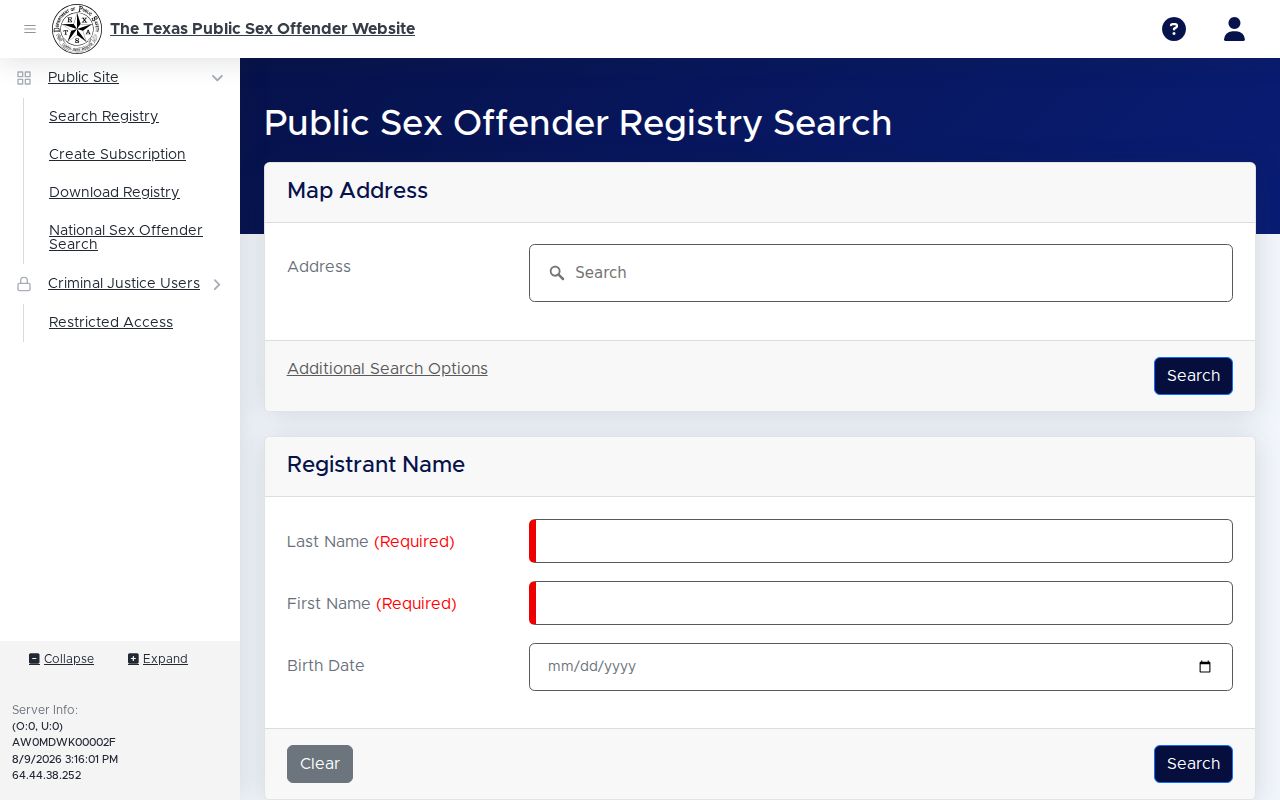
The search interface should be used for lawful safety awareness, with no harassment, threat, or vigilantism based on a listing.
Risk level does not set the registration term. Texas law can require ten years or lifetime registration based on statutory categories, while verification can occur annually, every 90 days, or every 30 days for certain groups.
Parker County Criminal Data Context
Parker County's July 2025 Census estimate was 184,767, up 24.6 percent from the 2020 estimate base. The county spans 903.72 square miles. That growth and scale help explain why records are spread among the sheriff, city police, four justice courts, municipal courts, two county courts at law, and two district courts. Raw incident or arrest counts should be read with an agency, year, and population base.
The DPS Crime in Texas resources provide official arrest, conviction, and reported-crime context.
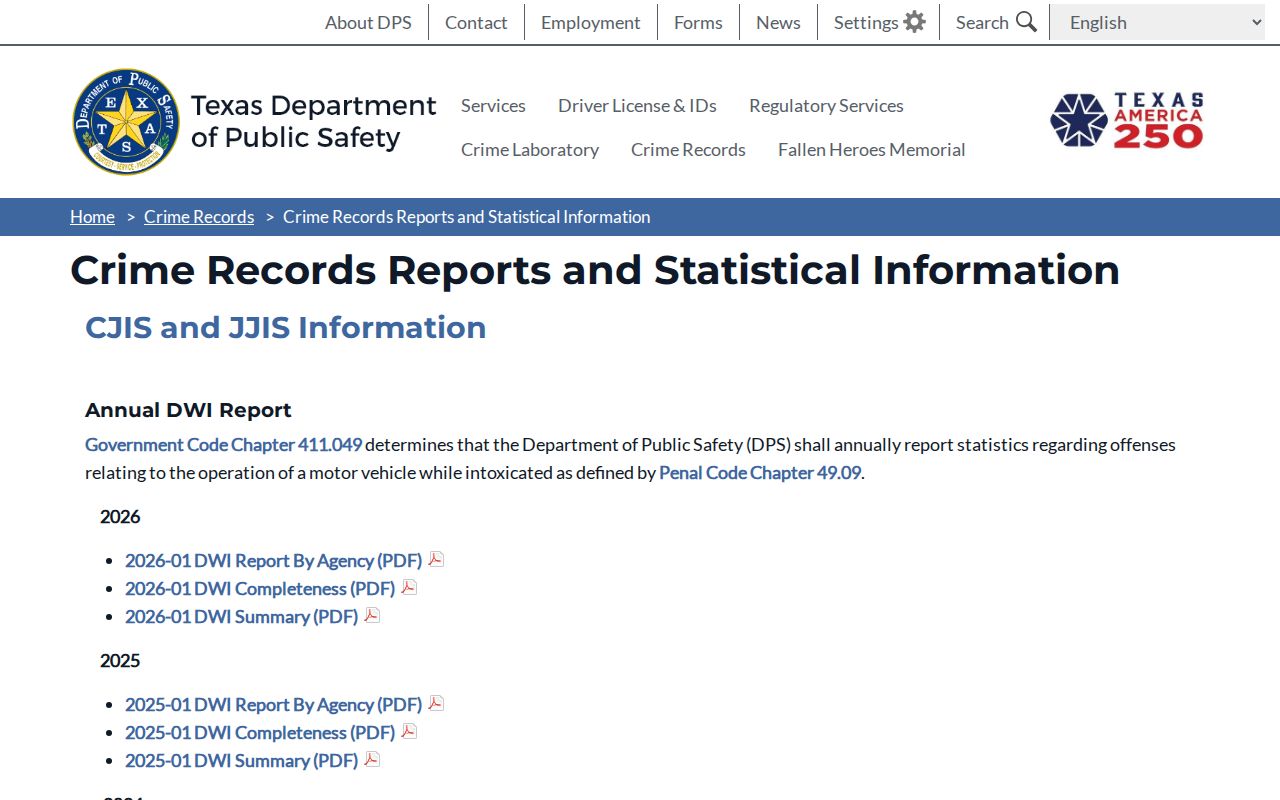
This state source supports trend work, but the researcher still must label the reporting agency and year instead of blending city and county figures.
Historic Parker County Criminal Records
A courthouse fire in 1874 limits early Parker County records. The Texas State Library reports that only two microfilm reels of case papers survived; county-court minutes begin in 1876. The present clock-towered courthouse was built from 1884 to 1886 and restored before its 2005 rededication. Historic researchers should not assume a modern online index proves a nineteenth-century file never existed.
Modern counters are split as well. The County Clerk handles county-court misdemeanor files around the courthouse complex, while the District Clerk owns felony district files. Sheriff's headquarters at 129 Hogle Street holds sheriff-created reports, and the jail at 612 Jameson Street holds booking and custody records. A record's age does not erase the need to identify its original custodian.
- Cause number
- The court's unique case identifier.
- Disposition
- The outcome of one charge.
- CCH
- The Texas DPS Computerized Criminal History repository.
- Capias
- A court command to arrest, often tied to an existing case.
Criminal Records by City in Parker County
Weatherford, Willow Park, and Aledo are Parker County's three largest incorporated cities by the official July 2025 estimates. Their police departments create local reports, and their municipal courts keep Class C, traffic, and ordinance files. A city arrest that leads to custody can still route to Parker County Jail, while its court record may stay with the city. Aledo also has a sharp custodian change because its first police department began operations in August 2025.
Weatherford Criminal History
40,634 · Police reports, daily media reports, and municipal court search.
Willow Park Criminal History
7,439 · Support Services requests and a municipal citation portal.
Aledo Criminal History
7,122 · Incident date decides between the new city police and prior PCSO custody.